
We dig into the potential scope of the Starlink market, SpaceX’s impact on the industrial gas investment space, and our perspective on xAI and orbital computing.
WRITTEN BY:
Nicolas Owens | Equity Analyst, Aerospace & Defense,
Suryansh Sharma | Director of Equity Research, Industrials and
Krzysztof Smalec | Equity Analyst, Industrials
The SpaceX IPO is shaping up to be one of the largest and most closely watched market debuts in recent memory: The company has redefined the economics of spaceflight, built a dominant position in global launch, and extended connectivity to places beyond the reach of traditional infrastructure.
The valuation, however, deserves more careful scrutiny. Morningstar equity analyst Nicolas Owens valued SpaceX at $780 billion—about 48% below its private market valuation. He also assigned the company a Morningstar Economic Moat Rating of Narrow.
Here, we map out our assessment of all things SpaceX. We dive into the factors behind our pre-IPO analysis, size the potential scope of the Starlink market, and explore how investors can gain meaningful exposure to SpaceX without buying SpaceX directly.
Research on this page includes:
- One Small Step for SpaceX, One Giant Leap of Faith for Investors
- When Unicorns Fly: SpaceX Prepares History’s Largest IPO
- Testing Sky’s Limits: Sizing Starlink’s Realistic Market Opportunity
- How to Play the SpaceX Story Without Buying SpaceX
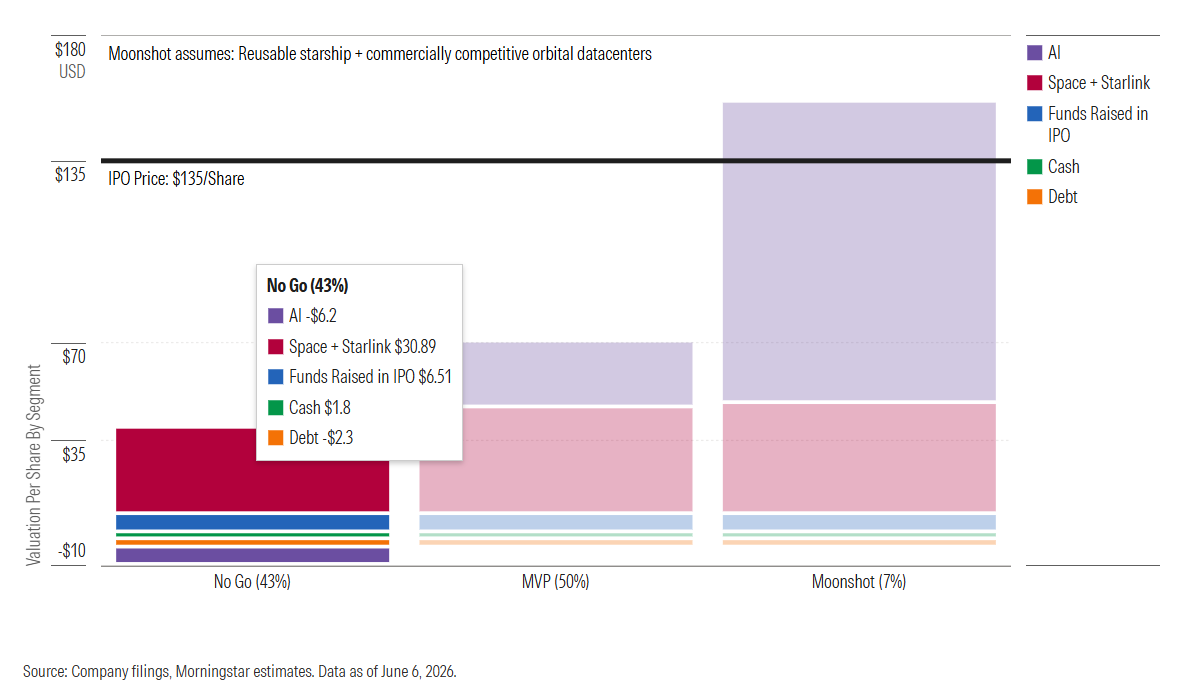
We value SpaceX at $63 per share, a 53% discount to the upcoming IPO price. Our valuation is the result of mathematics more than skepticism, reflecting a wide range of possible outcomes for the company’s financial future. Our probability-weighted DCF-based valuation incorporates three scenarios for the firm’s most uncertain artificial intelligence business.
Only the most optimistic Moonshot scenario, which requires a rapidly reusable Starship and commercially competitive orbital data centers, approaches the IPO price. The IPO price implies the Moonshot scenario is highly likely, but we think the outlook is very uncertain.
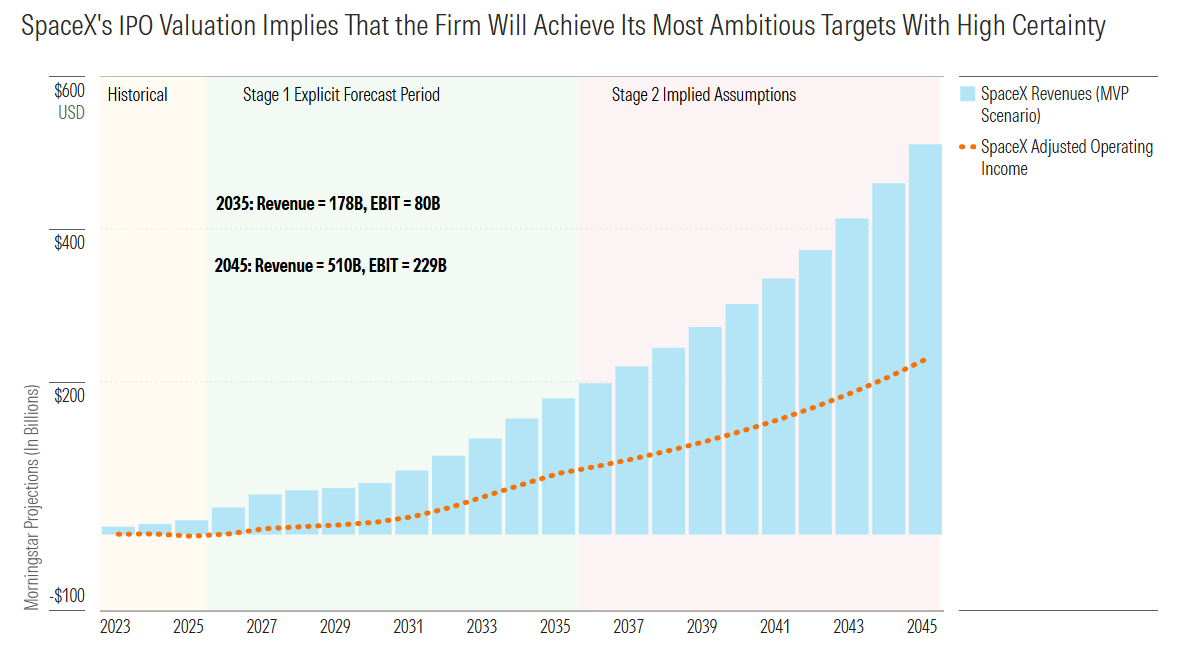
SpaceX’s IPO Valuation Implies That the Firm Will Achieve Its Most Ambitious Targets With High Certainty
- Our probability-weighted DCF valuation of SpaceX is $63 per share, and we think that the IPO price is significantly overvalued. Investors should wait for a better margin of safety.
- The valuation hinges on two unproven technologies: a rapidly reusable Starship upper stage and commercially scalable and competitive orbital AI data centers. We expect neither of these technological questions to be answered before 2028, even in the most optimistic scenario.
- We give SpaceX a lot of benefit of the doubt in two of the three scenarios, in which we assume the company can achieve a rapidly reusable Starship rocket enabling multiple launches per week and successfully commercialize data centers in space.
- The core space and connectivity businesses, which have much better visibility and relatively lower uncertainty, contribute about $40 per share to our fair value. These businesses form a solid foundation for SpaceX, but markets are excited about the AI segment.
- In the most optimistic Moonshot scenario for the AI business, the company successfully overcomes engineering constraints and rapidly scales orbital data centers to capture 20% of our forecast AI computing capacity by 2040; we value the stock at $154 per share.
- In our analysis, we assign the Moonshot scenario only a 7% probability. To justify the $135 offering price, one would need to assign a 77% probability to the Moonshot scenario and a 23% probability to the MVP scenario, which we view as overly optimistic given the nested improbabilities.
- If our probabilities for the AI business are correct, investors will be paying a $72 per share option premium for SpaceX’s long list of future ambitions (chip fabrication and Mars colonies, for example).